
Nearly 600 organisations have benefited this year from the services offered by the Navarre Digital Innovation Hub, IRIS, whose catalogue includes initiatives such as the Oficina Acelera PYME, the Data Science Laboratory and the Tourism Digital Transformation Laboratory. In addition, 40 entities have approved 48 services, bringing the total number of new services incorporated into the Hub to 156.
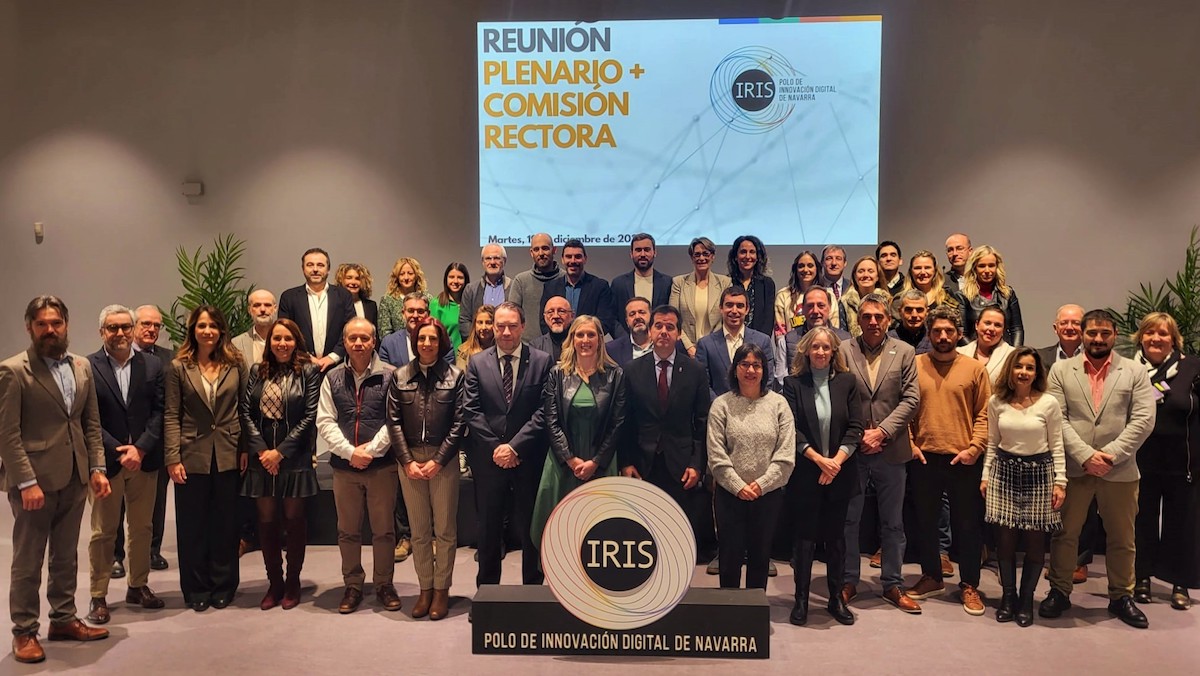
These are some of the figures presented at the meeting of the Governing Committee and Plenary of the Navarre Digital Innovation Hub, IRIS, which was opened by its president, the Minister for Universities, Innovation and Digital Transformation, Patricia Fanlo.
The Navarre Digital Innovation Hub, IRIS, is a public-private consortium, chaired and promoted by the Government of Navarre, in which the most relevant actors in the Navarre innovation ecosystem participate, including agents from the SINAI (Navarre de R&D&I System) such as universities, technology and research centres; ICT suppliers, professional, associations, business associations and sectoral clusters.
Speeches by Minister Fanlo and Minister Irujo
In her speech, the Minister emphasised ‘the essential role of the Hub as a tool for government collaboration to promote key issues, focusing on its work to strengthen the region by generating and applying technological talent’. Similarly, Fanlo pointed out ‘the need to work together so that companies, universities, technology centres and other entities contribute to accelerating the digital transformation of Navarre’.
In addition, the Minister emphasised the specific areas aligned with the Navarre Smart Specialisation Strategy (S4) and mentioned some key projects such as the Navarre Cybersecurity Center and the Navarre Artificial Intelligence Research Centre (NAIR Center). ‘The objective of the Digital Innovation Hub must be to develop a network specialising in technology to strengthen innovation and attract investment and talent to this region. We must aspire to be like Palo Alto (California) at the national level’, she concluded.
The opening ceremony was also attended by the Minister for Industry and Ecological and Digital Business Transition, Mikel Irujo, who was unanimously elected Vice-president of the Hub by all those present, representing the 37 public-private entities that form part of IRIS.
In this regard, Minister Irujo reaffirmed that Navarre is among the most innovative regions. ‘Through the creation of the Digital Innovation Hub (IRIS), we have gone one step further in reinforcing our commitment to the Navarre business community in the digital transformation’, he said.
‘Having the Hub is key to bringing together the efforts of all the agents involved: large and small companies, universities, organisations and everyone in society. Currently, 576 companies are already benefiting from the services and 156 services have been incorporated into the Hub. The Hub is definitely the benchmark for achieving the digital metamorphosis that we must achieve as a community’ he pointed out.
For her part, Delia Sola, director of the Strategic Projects Service at S4 an Entrepreneurship, was responsible for presenting the progress made on the refurbishment of the 4th floor of El Sario, which will be the physical headquarters of the Hub from April next year. Sola also provided details of the planned transfer of equipment, which will be located in the aforementioned facilities.
In addition to approving the creation of the position of vice-president of the Navarre Digital Innovation Hub, which has been filled by Mikel Irujo, the Governing Committee and the Plenary also approved the accession to IRIS of CNAI, a public company owned by the Government of Navarre that develops training activities aimed at the whole of Navarre society, focusing on three areas of action: digitalisation, languages and training for employment. The Strategic Plan for the Hub was also presented and approved during the meeting.
Ion Arrizabalaga, coordinator of the Navarre Digital Innovation Hub, presented the results of IRIS as set out in the scorecard of its strategic plan, which was also reviewed during this meeting, highlighting, in addition to the aforementioned data, the commitment shown by all the Hub’s stakeholders. Finally, the Governing Committee and the Plenary were informed of the actions planned for the first quarter of 2024.
Participating organisations
The Hub is made up of 38 public-private organisations: Government of Navarre and Pamplona City Council, Public University of Navarre (UPNA), Automotive and Mechatronics R&D Foundation (NAITEC), Navarre Industry Association (AIN), Navarra de Servicios y Tecnologías S.A. (NASERTIC), Navarre Association of Municipal IT (ANIMSA), ADItech Foundation (ADItech), University of Navarre (UNAV), Lurederra Technology Centre (Lurederra), National Renewable Energy Centre (CENER), National Centre for Food Technology and Safety (CNTA), Navarre Institute of Agri-Food Technologies and Infrastructures (INTIA), Spanish National Research Council (CSIC), Navarra Biomed, Centre for Applied Medical Research (CIMA), Atana-Navarre Cluster (ATANA), Navarre Wind Energy Cluster (Enercluster), Navarre Automotive Cluster (ACAN), Navarre Agri-Food Cluster (Nagrifood), Navarre Health Cluster (NHC), Construction Industrialisation Cluster (iCONS), NAIR Center, Navarre Audiovisual Cluster (CLAVNA), Functional Print Cluster, Navarre Chamber of Commerce, Industry and Services, Navarre Business Confederation (CEN), Sakana Development Agency (Dinabide), Official Association of Industrial Engineers of Navarre (COIINA), Association of Industrial Graduates and Technical Engineers of Navarre (CITI), Official Association of Telecommunications Engineers (COIT), Trabajos Catastrales S.A., Tracasa, Centro European Business and Innovation Centre of Navarre (CEIN), Development Society of Navarre (SODENA) and the recently incorporated Navarre Centre for Integral Learning(CNAI).
Source: https://www.navarra.es