Pamplona will on 6 May become the epicentre of Spain’s debate on Artificial Intelligence with the National AI Congress, a meeting that will bring together leading voices from across the country to examine how technology can be placed at the service of people and society.
Within the framework of the Navarra Digital Strategy 2030, the Government of Navarra is advancing in the responsible uptake of Artificial Intelligence in public services and in the productive fabric, with the dual aim of improving citizens’ lives and boosting competitiveness.
Among other developments, virtual assistants and chatbots are being used to facilitate procedures such as requesting certificates or arranging appointments; pilots are being deployed to streamline back‑office processes; and training actions are being expanded so that both public employees and companies can acquire the skills needed to use AI tools sensibly and with guarantees.
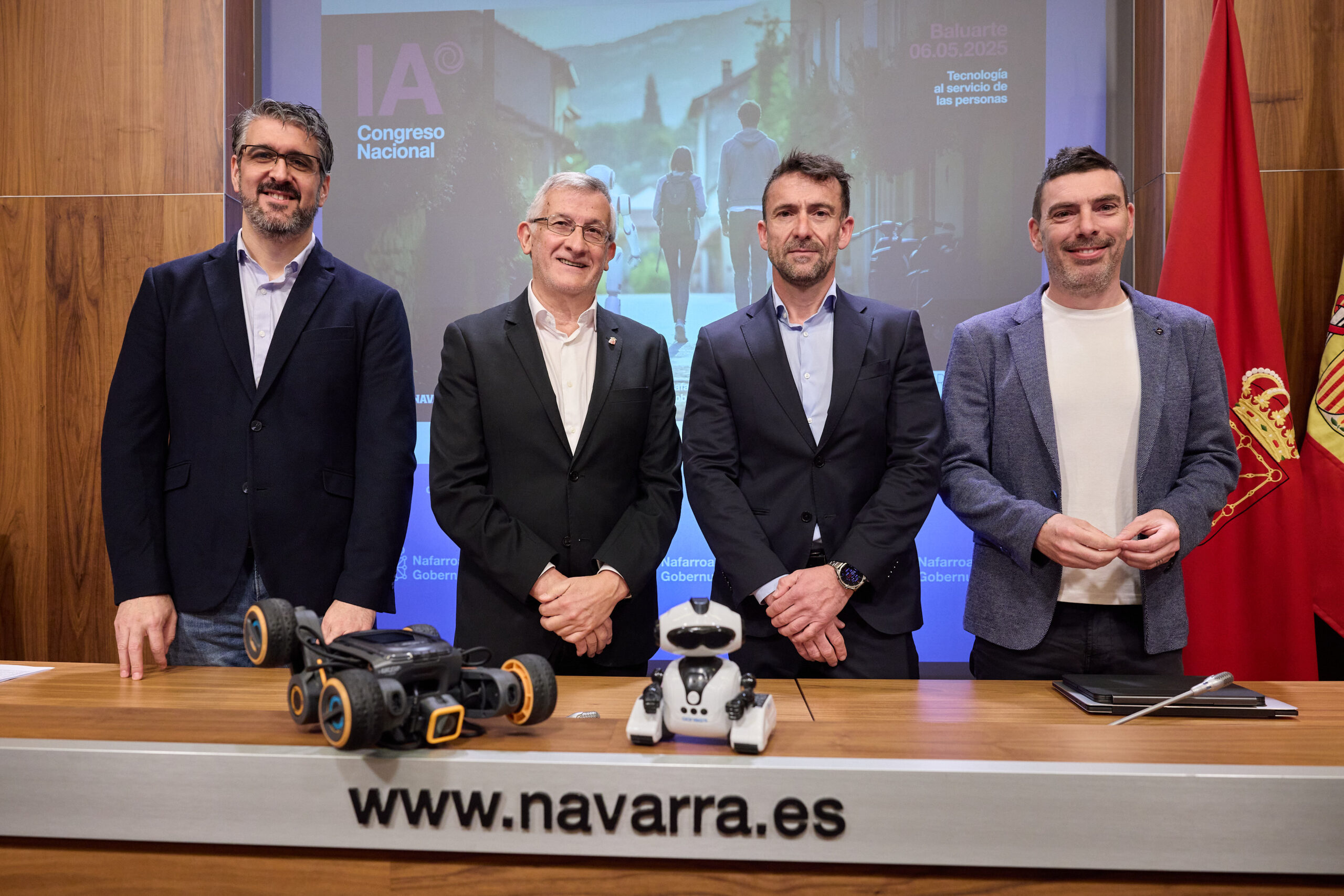
First Vice‑President and Minister for the Presidency and Equality, Félix Taberna, presented the main conclusions of the Government’s strategic monitoring of the AI landscape, together with the Director‑General for Digital Transformation, Rubén Auza, and NAIR Center’s Managing Director, Gorka García.
Navarra thus moves forward in its process of analysing how AI can be used to improve public services and the economy, identifying opportunities and guardrails so that innovation, rights and trust go hand in hand and so that new technological possibilities translate into concrete spaces for action and implementation.
At the press conference, Vice‑President Taberna announced the holding of the National AI Congress under the banner “Technology at the service of people”, an event promoted jointly by the Government of Navarra and NAIR Center and open to institutions, companies, the third sector and citizens.
Details of the study presented today
The document presented is the result of strategic monitoring of regulatory, technological and social developments in AI in Spain and Europe, with particular attention to critical aspects that can serve as a reference for Navarra.
One of the strands is specifically focused on the public sector in Navarra and has been carried out in collaboration with the Public University of Navarra (UPNA) and the National University of Distance Education (UNED).
In addition, a survey was conducted by the Official College of Sociology and Political Science of Navarra to gauge people’s perceptions and level of familiarity with AI tools, as well as their expectations and concerns. More than half of those surveyed had already tried some form of AI in their everyday lives and, in many cases, had done so in a largely self‑taught manner (six out of ten respondents).
The study also compiles technological trends in language models, computer vision and robotics; maps the regulatory context in Spain and the European Union (with emphasis on the EU AI Act); and reviews the opportunities and risks that organisations identify when adopting AI—ranging from gains in efficiency and quality to questions of transparency, bias, accountability and environmental impact.
With respect to companies, the Government highlighted initiatives aimed at accelerating digital transformation through Navarra’s Digital Innovation Hub (IRIS) and through specific support for testing and adopting AI solutions. These actions facilitate access to expert advice, test‑before‑invest facilities and training for professionals in the region.
In October 2024 the Government launched, via the Department for Universities, Innovation and Digital Transformation, a call to support projects for the integration of AI in SMEs and industrial value chains. The aim is to reduce barriers to entry and to ensure that companies can trial and implement AI in concrete processes where there is a clear return in quality, productivity or safety.
In terms of training, the Navarra Public Employment Service – Nafar Lansare has broadened its offer with specialised modules on the practical use of AI tools—such as ChatGPT, Gemini or Copilot—in professional contexts, all with the goal of improving productivity while making responsible use of the technology.
Also in April 2024, the Department for Universities, Innovation and Digital Transformation launched a public consultation to identify needs and opportunities for AI in the territory through a platform assisted by AI that allowed organisations to submit proposals and to comment on each other’s contributions.
At the UPNA, in October 2024, and together with Universidad Carlos III de Madrid, the first intake of the University Master’s in Machine Learning began, strengthening the region’s training ecosystem in advanced AI.
National AI Congress in Pamplona on 6 May
The National Congress on Artificial Intelligence, organised by the Government of Navarra and NAIR Center, will bring together specialists to examine how to guarantee that the deployment of AI protects rights and contributes to a fairer and more inclusive society.
With this initiative, Navarra seeks to foster a conversation that regards technology not as an end in itself, but as a tool to improve people’s lives, to modernise public services and to strengthen social cohesion.
The event will be attended by the First Vice‑President and Minister for the Presidency and Equality, Félix Taberna; the Regional Minister for Universities, Innovation and Digital Transformation, Juan Luis García; and NAIR Center’s Managing Director, Gorka García.
The morning programme will feature a keynote address by Alfonso Lara (European Social Network) and round tables with experts such as Mercedes Siles Molina, Ulises Cortés, Pilar León Sanz, Margarita Castilla Barea and Jaime García Cantero, Director of Retina at PRISA Media, among others.
In the afternoon the Congress will resume with a hands‑on panel on real‑world AI use cases bringing together Alicia Asín (Libelium), Mar Pereira (Xunta de Galicia) and Marisol Gómez (Professor of Algebra and Scientific Director of NAIR Center), among others.
Useful links