Vice-President Taberna highlights that “Navarra is a territory of vanguard and innovation”, with departments and public companies that have been incorporating AI since 2018 in the public sphere and in the business ecosystem.
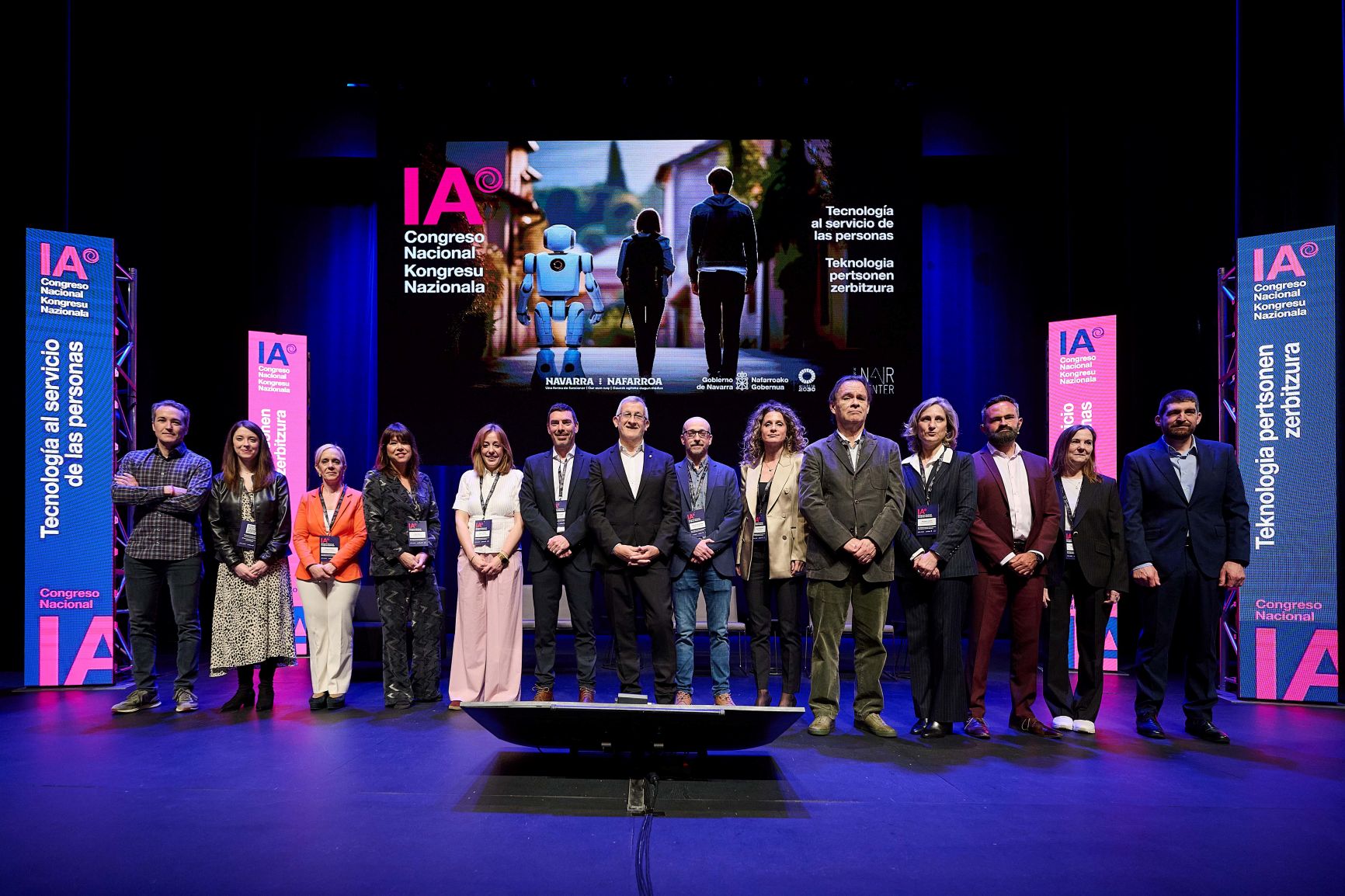
The Baluarte Conference Centre and Auditorium in Pamplona / Iruña today hosts the presentation of the National Congress on Artificial Intelligence ‘Technology at the Service of People’, a flagship event promoted by the Department for the Presidency and Equality of the Government of Navarra and NAIR Center (Navarra Artificial Intelligence Research Center), with the collaboration of Centro VIDAAS. Its purpose is to place the Chartered Community at the forefront of debate on the role of artificial intelligence in society.
This congress sits within Navarra’s digital transformation strategy, which supports an ethical, sustainable and humanist implementation of artificial intelligence. Rather than taking a purely technological approach, the event adopts a cross-cutting perspective that addresses the social, legal, economic and cultural dimensions of AI, fostering open dialogue among experts, institutions, the business sector, academia and the public.
Ethics, collaboration and civil rights in a digitalised environment
Throughout the day, which brings together more than 400 people, three major strategic strands are addressed: ethical reflection on the design and use of AI systems; analysis of its impact on key sectors such as employment, education, health and the environment; and the need to build a collaborative innovation ecosystem bringing together universities, research centres, public administrations, technology companies and civil society.
The session begins with a welcome from Gorka García, Managing Director of NAIR Center, who highlights Navarra’s strategic role as a territory committed to people-centred AI. Next, Félix Taberna, First Vice-President and Regional Minister for the Presidency and Equality of the Government of Navarra, speaks of the importance of collective thinking as a driver of technological progress: “Knowledge advances when it meets. Major technological transformations do not arise from isolation, but from the crossing of knowledge, sectors and generations. Companies, universities, institutions and citizens must cooperate and think together,” he notes.
Taberna also calls for a new ‘digital Enlightenment’ that combines technology and conscience: “Just as, in the eighteenth century, reason was demanded in the face of dogma, today we need a defence of humanity and ethics in the face of creating artificial intelligence without reflection. Technology and conscience must go hand in hand to build a freer and more egalitarian society.”
The opening keynote is delivered by Leonardo Cervera, Secretary-General of the European Data Protection Supervisor, who analyses the different international models for AI development and the challenges of the European approach, especially in terms of regulation, privacy and ethics.
Alfonso Lara, Executive Director of the European Social Network, gives the second keynote of the morning, focusing on the social transformation that artificial intelligence is already generating and on the future that this technology is outlining for European citizens.
The first panel discussion, entitled ‘AI and ethical algorithms: challenges and solutions’, brings together Mercedes Siles (University of Málaga), Pilar León (University of Navarra) and Ulises Cortés (UPC and Barcelona Supercomputing Center). Moderated by Rosa Jaso, they address moral dilemmas and the frameworks for action needed to ensure fairness and transparency in algorithmic systems.
After the break, the second panel discussion explores ‘Digital rights and AI regulation’ in greater depth. Aritz Romeo (Public University of Navarra), Leire Arbona (Veridas), Margarita Castilla (University of Cádiz) and Cristina Villasante (ECIJA) debate legislative progress and legal safeguards in new digital scenarios. Pilar Bensusán (University of Granada) acts as moderator.
The programme continues with an open debate on the ‘Benefits and risks of AI: knowledge, judgement, capability?’, with the participation of Maria Moya (Prodigioso Volcán), Carlos Fernández de Vigo (Dr. Platypus & Ms. Wombat), Luis Villa del Campo (Accenture Europe) and Àurea Rodríguez (EIT Culture & Creativity), moderated by Ángela Bernardini of NAIR Center. The speakers analyse how to prioritise human values in the design and use of AI.
The third panel discussion is entitled ‘Applications of AI in society: success stories, social innovation and trends’. Speakers include Marisol Gómez (NAIR Center and UPNA), Idoia Urmeneta (Centro VidAAs), Gemma Botín (Fundación Caja Navarra) and Mar Pereira (Xunta de Galicia), moderated by Paloma Llaneza (Razona LegalTech). The speakers share concrete examples of how AI is already helping to improve public services, healthcare and smart rural development.
In the interview held under the heading ‘AI and social structure: where are we heading?’, Jaime García, Director of Retina (PRISA Media), talks with Enrique Goñi, President of the Hermes Foundation. The conversation is led by Luisa Alli, Managing Director of the same entity.
The final keynote is delivered by Alicia Asín, CEO and co-founder of Libelium, who addresses the transformative role of artificial intelligence as a tool to improve quality of life, from health to urban sustainability.
The institutional closing is delivered by the Regional Minister for Universities, Innovation and Digital Transformation, Juan Luis García, who highlights in his remarks Navarra’s commitment to a model of technological development centred on citizens. “Artificial intelligence is not an end in itself, but a tool to improve lives and build a fairer, more inclusive and more sustainable society,” he states.
The Regional Minister García also explains that Navarra “is working with determination to position itself at the forefront of digital transformation, with a model based on ethics, transparency and talent”. In his remarks, he stresses that AI “does not replace public services; it enhances them”, referring to projects already under way in education, health and justice. “AI must serve to expand the best of human capability,” the Regional Minister maintains.
Navarra, a territory of vanguard and technological innovation
It should be recalled that, since 2018, the different departments and public companies of the Government of Navarra have been promoting various actions to incorporate Artificial Intelligence both in the public sphere and in the business ecosystem, as First Vice-President Félix Taberna indicated in his remarks.
Among these, the creation in 2022 of NAIR Center itself stands out: Navarra’s AI research centre, conceived to improve the competitiveness of the productive fabric and to make the Chartered Community a benchmark in this field. This centre works closely with the Navarra-IRIS Digital Innovation Hub to develop strategic areas such as intelligent data processing, machine learning, disruptive AI and the interaction between artificial intelligence and society.
In the health sector, some diagnostic-support tools are already being used in the public health system, with healthcare professionals always supervising the entire process, as in the case of the early detection of diabetic retinopathies.
In the social sphere, the Government of Navarra has been exploring applications and approaches to optimise the use of AI in the area of social and healthcare support, in collaboration with Centro VidAAs and NAIR Center.
In the administrative sphere, tools for extracting unstructured data have already begun to be used for the management of grants involving large volumes of data, as well as virtual assistants or chatbots, notably those recently incorporated into various citizen service channels of the regional Executive, and the two life-size avatars that act as virtual guides at the General Archive of Navarra, under the names ‘Archibaldo’ and ‘Archibalda’. Text-generation tools are also used to reduce the time devoted to administrative tasks.
In October 2024, the Government of Navarra launched, through the Department of Industry and of Ecological and Digital Transition for Business, the first edition of the NavIA Lab S4 Artificial Intelligence Laboratory, an event offering practical training, mentoring and the implementation of AI solutions in specific business processes.
With regard to training, the Servicio Navarro de Empleo – Nafar Lansare has been offering various courses to support digital skills at different levels, notably those aimed at acquiring advanced skills in Artificial Intelligence, generative AI to improve productivity, ChatGPT, Gemini or Copilot.
In April 2024, the Department for Universities, Innovation and Digital Transformation of the Government of Navarra received the recognition ‘AI for the improvement of Citizen Services’, for a project that has strengthened digital skills and fostered technological inclusion across the territory through an AI-assisted platform.
With regard to UPNA, in October 2024 it promoted, in collaboration with the public company Tracasa, the Tracasa Chair in Computer Science and Artificial Intelligence. In addition, for the 2025–2026 academic year, the first year of the University Master’s degree in ‘machine learning’ (aprendizaje de máquinas) is planned.
A commitment to public–private collaboration
The National AI Congress hosted by Pamplona makes it clear that advances in artificial intelligence cannot depend on isolated efforts. Its development requires constant collaboration between the public and private sectors, as well as a shared commitment to citizen participation and transparency in decision-making. In this respect, Navarra argues for an integrative approach, in which administrations, companies, research centres and civil society work in a coordinated manner to define the course of a technology that will shape the territory’s economic and social future.
Thus, the Chartered Community positions itself as a laboratory of open innovation, both social and technological, that promotes experimentation, knowledge transfer and the design of people-centred solutions. This strategy aligns with the guidelines set out in the Draghi Report on European Competitiveness, which underlines the urgency of strengthening digital sovereignty, reducing external technological dependence and building an economy sustained by knowledge, innovation and talent.
In short, Navarra is committed to a model of AI governance that combines institutional leadership, business momentum and shared social responsibility, with the aim of ensuring that technological development translates into collective well-being and contributes to a fair and sustainable transformation.
An AI consistent with the European Union’s digital rights
With the holding of the National Congress ‘Technology at the Service of People’, the Government of Navarra consolidates its commitment to an artificial intelligence designed to address social challenges from an ethical and inclusive perspective. The regional Executive is thus committed to an AI conceived as a tool for collective development, aligned with the Charter of Digital Rights and the Declaration of Digital Principles and Rights of the European Union.
Likewise, Navarra’s strategy is articulated in line with the pillars of the National Artificial Intelligence Strategy (ENIA) and aligns with the guidelines of the European AI Strategy, promoting a model of artificial intelligence that prioritises innovation without compromising legal certainty or people’s fundamental rights.